
News
You will find interesting news and information here as part of our commitment to educate our teams, suppliers and our clients on the importance of sustainable and environmentally sound business practices.
News | Growing Seeds of Hope for the Cape Parrot
Growing Seeds of Hope for the Cape Parrot
May 13 2024 By Paper Pledge paper, pledge, parrot, forest
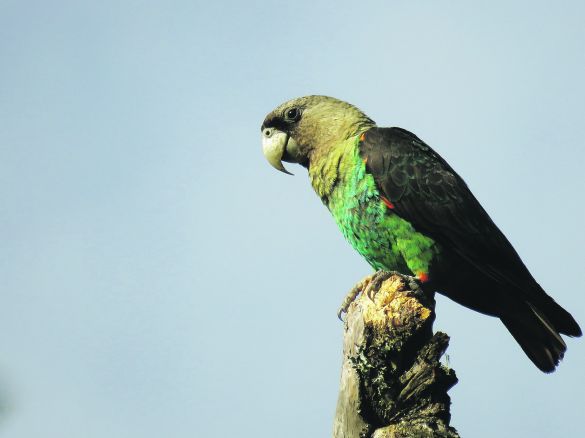
A woman in her 70s is doing all she can to help re-establish the endangered Cape parrot's habitat, while simultaneously earning an income.
A single seed in Nozibele Mphothulo's hands brings with it hope to save the critically endangered Cape parrot.
Affectionately known as Mamma Evelyn, Mphothulo is a tree grower at Siyazama Nursery in Sompondo, near Hogsback in the Eastern Cape.
She is part of non-profit organisation Wild Bird Trust's Cape Parrot Project, which has been striving to protect South Africa's only endemic parrot since 2009, by re-establishing its natural forest habitat.
Wild Bird Trust's ultimate aim is to link conservation to economic benefits by uplifting small, rural communities surrounding the parrot's habitat.
To increase on-the-ground forest protection, the Cape Parrot Project encourages local people to become Afromontane forest custodians by showing them how they can make a
living while ensuring forest sustainability.
In South Africa, Afromontane forests cover only 0.5% of the country's land area. They occur in pockets along mountain ranges in well-watered areas, including ravines and south-
facing slopes. Under the vivid green canopy of trees lies a lush wonderland filled with a spectacular variety of plants, animals, insects and birds.
The Forest is My Home
Mamma Evelyn, who is in her 70s, has always lived in the area and calls the neighbouring forest her home.
Along with other growers, she collects indigenous seeds from trees in the community and the forest edge, germinates them and grows them into healthy seedlings at the nursery, which was established in 2017.
"We plant a seed, we grow a seed and the seed grows and gives life - we just need to love the seed. A small seed can save the life of a bird or animal. And if we all plant some seeds, we can save many animals' lives," she says.
The Cape Parrot Project purchases the seedlings when they reach planting height.
For most growers, this is their primary source of income.
Mamma Evelyn is the nursery's pioneer. In addition to her passion for growing trees and her dedication to the initiative, she also supports the other growers in any way she can.
The income she receives from the tree sales has enabled her to purchase rainwater tanks for water security, fence off her food garden and support her large family.
Although Mamma Evelyn grows a diversity of trees, indigenous yellowwoods are what she is best known for. Over several years, thousands of these trees have been planted in and around the forest habitat, creating a future food source for the Cape parrot.
When she retires, she says she would like to pass her knowledge to the next generation, which truly represents the meaning of Siyazama - 'working together'.
Fewer than 2 000 Cape Parrots
Listed as critically endangered - a species facing an extremely high risk of extinction - there are less than 2 000 Cape parrots left in the wild.
They are limited to forest patches in the Eastern Cape, KZN and Limpopo.
The parrots nest in existing tree hollows in old yellowwood trees and rely on their fruit for nutrition and survival.
As yellowwood trees are scarce, largely due to habitat degradation caused by historical logging practices, there's a shortage of natural nesting sites. Today, these trees are
protected by the National Forests Act 1998.
"Our goal is to achieve sustained growth in the population of this rare parrot species, and with strategic partnerships, we are working towards a total wild population of 2 500 birds within the next 10 years," says Dr Kirsten Wimberger, director of the Cape Parrot Project and trustee of the Wild Bird Trust.
The Cape parrot's limited habitat is under threat due to numerous human-induced factors, including the over- exploitation of natural resources, the proliferation of exotic plants and depleted groundwater supplies, she adds.
"These all contribute to habitat degradation and, ultimately, a lack of nesting sites and food for the species.
"The plan is to protect and improve Cape parrot forest habitats, thereby halting the habitat degradation driving their decline, and providing conservation actions needed to improve population numbers."